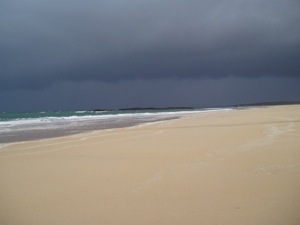
The wind had been in the south for nearly a week, so migration had been on hold. Wednesday dawned with the wind raging against the north end of the house, drumming the rain against the window. Fishing was going to be an experience today. As you crest the Committee Road, the expanse of Vallay Strand is laid put in all its glory in front of you. The deep blues signifying the slightly deeper water and the shallower water running through all the variations of yellow until it actually becomes solid sandbanks as the tide recedes. The tide was running north against the wind, raising breaking waves as it rushed towards the Atlantic, but also churning the sand up, so that it looked like the water was half sand and water. I knew the tide ran strongly between us and the sea pool, but in this wind we needed to get to the other side to even have a chance of casting in this maelstrom. It was running too fast to cross safely – we were going to have to wait until it dropped further. As we waited rain squalls came in off the Atlantic which the wind drove into us like hail, even though we were cowering behind the only available rock. A quick step out into the unknown and deepest part of the ford, but soon across with the rods and then back for Duncan and Susan. I am sure they were beginning to wonder if wading chest deep into this seemingly endless expanse of water was advisable, but soon we were fishing with the wind. Another squall and then blistering sun, then another squall – we were going to earn any fish we caught. With the return of the sun came the sound of yapping small dogs from high above us – the northerlies had brought another visitor from the far north in the shape of the amazing Barnacle Goose. The first three parties were family groups of two adults and one or two juveniles who would have stuck together during their long haul from Iceland, as well as the flight down from the high Arctic of Greenland or Svalbard where they nest high in the cliffs. For years people wondered how the gosling got from these inaccessible nests to the lochs below where they grow up. It was thought that the adults carried them on their backs, but the truth turned out to be much simpler – they jump, encouraged by their parents into a day old display of freefall. So these juveniles had survived a long fall and a long flight.
Within 24 hours the three small groups I had seen were quickly joined by a vast group on Kyles strand in a long line of resting geese that stretched for at least half a mile of silent birds. For the next four days the weather has been Mediterranean up here, making a visit to Harris fishless, but perfect for more Barnacles to arrive (as well as numerous wheaters and a redwing – the arctic really is coming south) until the island seems full of them – we must have seen groups totalling 10,000 in the last two days. They seem to prefer to roost on sand, so we now have our own resident group of about a thousand who spend low tide on Loch Paible, gently yapping at each other and occasionally taking fright at anything, including the Tuesday helicopter from St Kilda. They have reason to be wary on the island, but they need to listen to the local ravens if they want an early warning.
Our ravens spend a great deal of time on the chimney pots of Balranald House, from where they survey the local area like the local tacksman who used to lived there. Nothing stirs without them investigating, especially if it is a bird of prey. So it is always worth checking out why they are making their chastening call. Last night it was really worth it because flapping back from a foray over the exhausted geese was a white-tailed eagle. After a long flight from Iceland the geese are prey for even the rather laboured flight of the sea eagle. It will no doubt return to test the geese’s wariness until they depart for their final destination on Islay, the Solway and the west coast of Ireland.
Mobbing of eagles by other birds is a great way of finding eagles, but sometimes eagles attract things that you might miss. As we lay in the sun high up on a hill above Kyles and the barnacles, two eagles circled above us, like vultures in a 50s cowboy movie. Bored with the lack of carrion, one called to the other and they were off across the valley to seek richer pickings. Watching them slowly disappear, they were joined by another dot hurtling in from above them. A peregrine disgruntled by their invasion of its air space decided to make a warning fly past. The eagles seemed unperturbed, but the peregrine did keep its distance, only once causing evasive action from the eagle.
It was the yapping of wary geese that called me out with binoculars this morning to see what the fuss was about – perhaps another eagle visit. The geese seemed to have misidentified a heron as a possible threat, so I swung on to our freshwater loch to see if the heron’s mate was fishing the margin. It wasn’t a heron that was fishing the loch. Amazingly, right in front of the house, an otter was happily chasing something around the bottom of the loch, appearing occasionally before diving and then reappearing at the end of a trail of bubbles. We watched it for fifteen minute before going back to our porridge.
The wind has now gone round to the south, so maybe the geese will stay with us for a little while longer. I hope the otter stays in our loch for even longer.
57.597815
-7.495077
 Thoughts from the edge